
Six Vaccine Doses
From One Vial
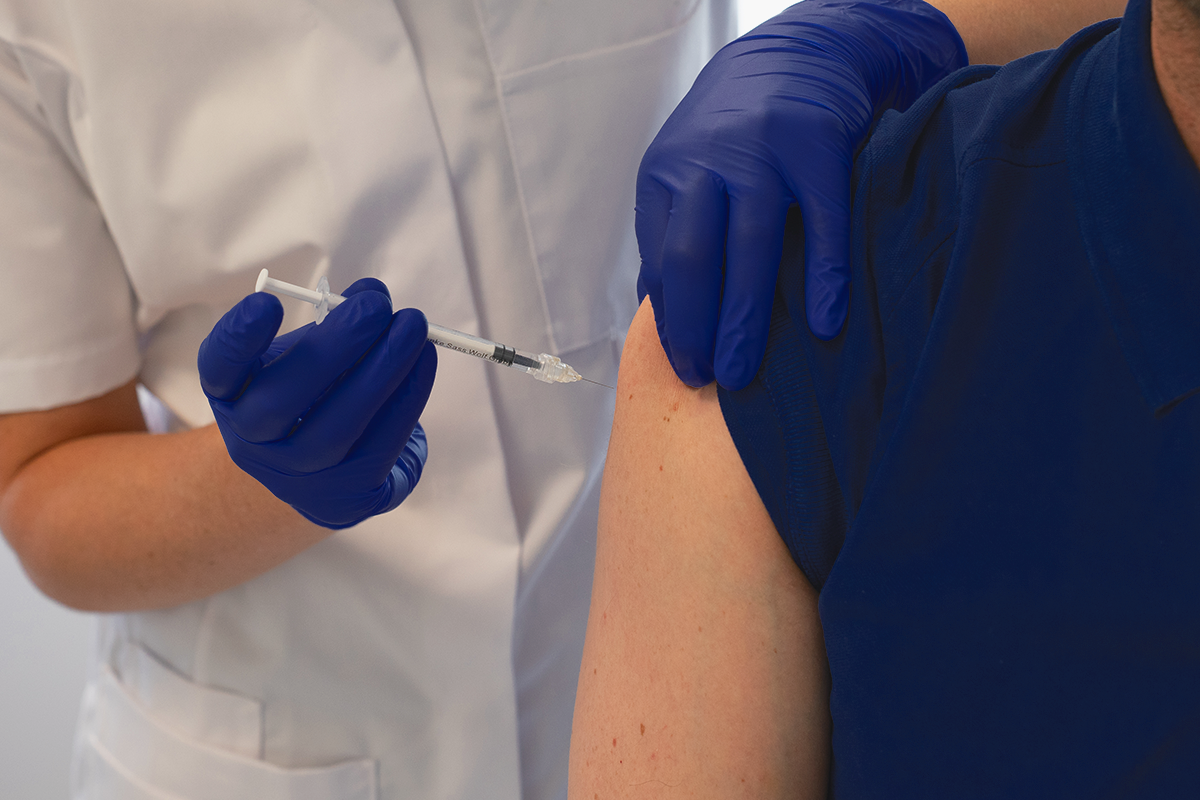
The inside story of how a precision needle company stepped forward during the COVID-19 crisis.
60M needles delivered
3M+ per day at peak
3 Months delivery window
6 Doses per vial
The phone call came in the winter of 2021, at the worst possible moment in Japan’s pandemic response. On the other end of the line: an official from the Ministry of Health, Labour and Welfare in Tokyo. The message was urgent. Japan was about to begin vaccinating its population against COVID-19 — and there was a problem with the needles.
The Pfizer-BioNTech vaccine, approved by Japan’s regulators on February 14, 2021 — the fastest drug approval in Japanese history — was designed to yield six doses per vial. But the two hundred million standard syringes the government had stockpiled could only extract five. After each injection, a small but significant pocket of residual liquid remained trapped in the dead space of the needle hub. At scale, across tens of millions of vials, that meant millions of doses evaporating unused onto hospital trays.
The ministry had one question: could a company called ACollaboratory —TSK International Japan at the time — help? Its patented STERiJECT Low Dead Space (LDS) needle was already known to Pfizer’s procurement team. In theory, it could solve the problem entirely. In practice, the government needed sixty million of them, and it needed them within three months.The dead space problem.To understand why ACollaboratory’s needle mattered, it helps to understand dead space. In any standard hypodermic syringe, when the plunger is fully depressed, a small hollow cavity inside the needle hub retains fluid that can never be delivered. On average, a conventional needle wastes approximately 99 microlitres per injection — nearly a tenth of a millilitre. When the dose in question is 0.3 ml of the Pfizer vaccine, that is not a rounding error. It is the difference between five doses and six.
ACollaboratory had anticipated this problem fourteen months before Japan’s vaccine rollout. In October 2020, as the first vaccine candidates entered late-stage clinical trials, the company’s European division published a white paper making the case that low dead space needles would be essential for efficient mass vaccination. The logic was straightforward: with potentially billions of doses required globally, any technology that reliably extracted more doses from a finite supply of vaccine was not merely useful — it was a strategic necessity.
The STERiJECT™ LDS needle addressed the problem by redesigning the needle hub itself. Using an extremely hard polymer with exterior threading, the hub was engineered to reduce residual space as close to zero as physically possible. The result was a tighter Luer lock connection that prevented flexing, eliminated leakage, and saved up to 0.09 ml per injection compared to a conventional needle — four times more than what an LDS syringe alone could recoup.
Independent validation arrived in February 2021, just days before Japan’s vaccination campaign began. A study by Eurofins Materials Science confirmed the numbers: when the STERiJECT™ LDS needle was paired with a compatible low dead space syringe, six full doses could be drawn and administered with 99.98% confidence. A conventional combination reliably managed five. The evidence was unambiguous. The question was whether production could be scaled to meet the moment.
Sixty million needles, on time. The Ministry of Health’s first order — placed in February and April 2021 — had a delivery deadline of the end of June. The official documentation tells its own story: MHLW circulars from March 12 and June 17, 2021, sent to health authorities in all 47 prefectures, named the STERiJECT™ LDS needle as one of the approved combinations for six-dose extraction. From the third wave of priority healthcare worker vaccinations onward, the STERiJECT™ needle was standard-issue.
The approved combinations listed in ministry guidance were precise: the B.Braun syringe paired with the STERiJECT™ LDS needle, or the BD Luer-Slip syringe with the same needle, or the Terumo tuberculin syringe — again with the TSK needle. The ministry’s written caution was equally direct: “Please note that combinations other than those listed may not allow six draws from one vial.” The STERiJECT™ needle was not merely one option among many. It was the active ingredient in Japan’s six-dose strategy.
The groups served in sequence tell the story of Japan’s vaccination priority order: healthcare workers first, then Olympic-related personnel ahead of the Tokyo Games, then the elderly, then the general public as the rollout expanded nationwide through the summer and autumn of 2021. At every stage, the six-dose guarantee that STERiJECT™ needle enabled meant more people vaccinated from each precious vial during the months when supply was at its most constrained.
By the end of June 2021, all sixty million needles had been delivered. Every unit had shipped on schedule. ACollaboratory had accomplished in three months what had seemed, on paper, arithmetically impossible.
From crisis to catalyst.The consequences of the COVID-19 campaign for ACollaboratory were transformative. Delivering sixty million precision needles to the Japanese government — on time, to specification, in the middle of a global logistics crisis — was the kind of proof-of-concept that no sales presentation could replicate. The ministry’s confidence translated into continued investment and procurement. The company’s international profile, already growing through offices in Japan, Canada, the Netherlands, and China, accelerated sharply.
The production capacity projections that had seemed ambitious in early 2021 were rapidly revised. Under the base plan, STERiJECT™ LDS needle output would grow from 94 million pieces in 2021 to 288 million in 2022. With two additional production lines already planned, the ceiling rose further still — to 816 million pieces per year at full build-out. Plans for operations in the United States and Australia moved from aspiration to active development.
The product portfolio continued to evolve too. A new 2mm LDS needle was in development, designed for intradermal delivery — a more precise technique than the century-old Mantoux tuberculosis test method, and potentially critical for future vaccination programmes requiring careful dose-sparing. The lesson of the pandemic — that the difference between five doses and six, multiplied across millions of vials, is a number that saves lives — had established a permanent commercial logic for the LDS technology.
What the numbers actually mean.
It is worth pausing on the arithmetic one more time, because the scale is easy to miss in the abstraction of policy documents and procurement circulars. Japan administered approximately 180 million vaccine doses in 2021. If even half of those were drawn using conventional five-dose needles rather than six-dose LDS needles, the difference represented, conservatively, tens of millions of additional doses that could have been administered — not by producing more vaccine, which would have taken months and billions of yen, but simply by changing the needle.
That figure — the silent extra doses unlocked by better engineering — is what TSK Laboratory’s white paper had argued in October 2020, before a single approved vaccine existed. The company had been right. And when the moment came, it had been ready.
That is the story of ACollaboratory and the sixty million needles. Not a story of breakthroughs or moonshots or venture capital. A story about decades of patient precision work, a product that was quietly ready when the world needed it, and a team that rose to the moment.


Ready to
collaborate?
Whether you are a healthcare professional, pharmaceutical partner, distributor, or researcher, we invite you to explore how ACollaboratory can support your goals.
Follow Us